
 Buy & Sell
 All EV Sales
 Explore
 Account
 Back to News
 Over the past two decades, the world of electric vehicles (EVs) has evolved at an astonishing pace. Early models that surfaced around the turn of the millennium were rudimentary, low-range machines, vastly different from the high-performance, long-range EVs available today. Back then, electric mobility was more of a novelty than a practical mode of transport. Yet, the advances since those humble beginnings have not only transformed mobility but also inspired inventive experiments that blur the line between sustainability, engineering, and sheer curiosity.
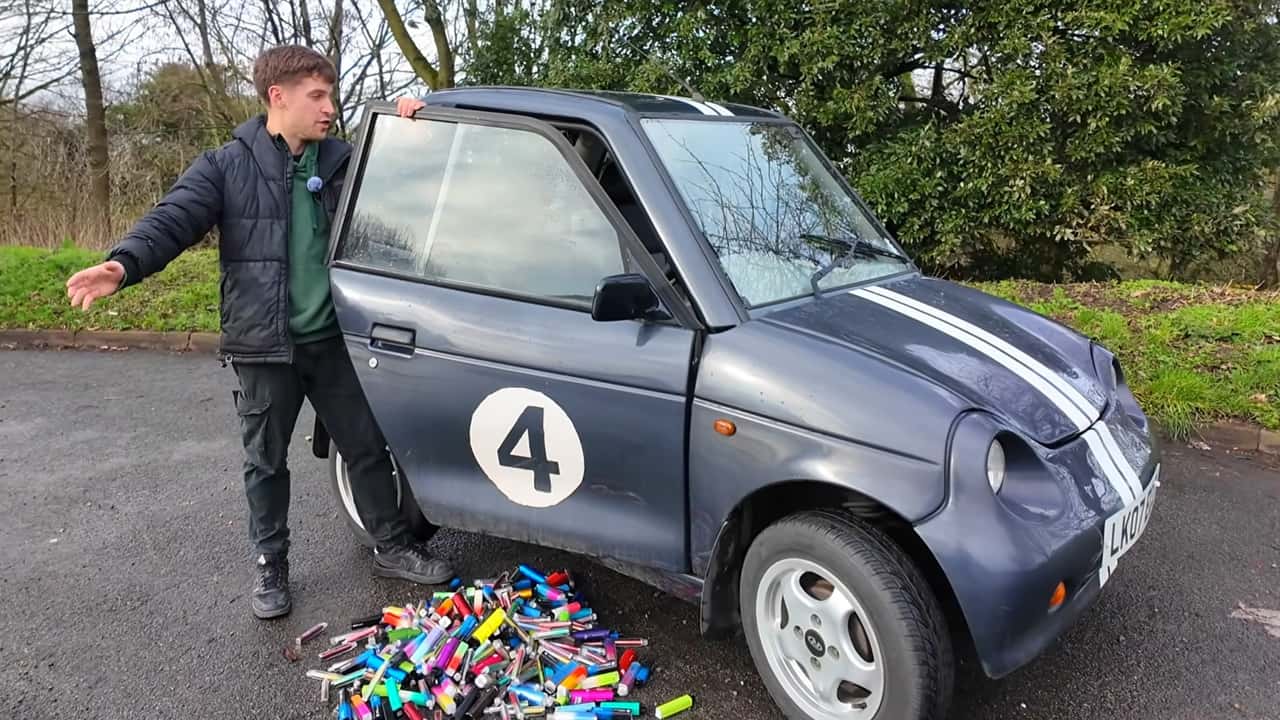
One particularly fascinating example is the work of YouTuber and engineer Chris Doel, who set out to demonstrate that even the humble lithium-ion batteries inside disposable vaping devices have untapped potential. Disposable vapes are everywhere—compact, colorful, and designed to be tossed after use. Yet, their lithium-ion cells often remain in good condition even after the liquid inside runs out. Millions of these devices end up in landfill each year, contributing to electronic waste and environmental concerns. Doel’s project flips that narrative, proving that the small batteries many view as waste can have a second life with a bit of ingenuity and technical expertise.
Doel set himself an ambitious goal: to power an actual car using only cells harvested from discarded vapes. The vehicle he chose for this bold experiment was the G-Wiz, a tiny British electric microcar that first appeared in 2001. The G-Wiz was one of the earliest attempts to bring electric mobility to everyday commuters, but its early lead-acid battery system was limited in range and performance. The stock power system provided around 48 volts, with the car topping out at about 50 miles per hour and an approximate range of 50 miles per charge. At the time, that was barely adequate—and by modern EV standards, it's rudimentary.
In his project, Doel collected roughly 500 vape batteries, each removed from disposable e-cigarettes. He tested them individually to ensure safety and performance, then grouped them into modular units that could be assembled into a larger battery pack. These groups were housed in custom 3D-printed enclosures—each row containing multiple cells for easier configuration and replacement. Once the modular sections were completed, fourteen rows were wired in series to create a 50-volt, 2.5-kilowatt-hour battery system.
While 2.5 kWh might sound small compared to modern automotive batteries—some EVs now boast packs exceeding 100 kWh—this hand-built unit was remarkably close in voltage to the G-Wiz’s original setup. That meant, at least electrically, it could function as a direct replacement for the car’s outdated lead-acid pack.
Safety was a central consideration in the project. Because lithium cells can be volatile when mistreated, Doel incorporated a comprehensive set of protections. Each cell was equipped with an individual fuse, and the entire assembly was managed by a battery management system (BMS) designed to balance voltages and prevent overcharging or deep discharging—conditions that can lead to overheating or fire. In addition, multiple temperature sensors were installed to monitor heat generation during use and charging, adding another layer of safety. The finished battery pack was enclosed in a sturdy aluminum case for physical protection and heat dissipation.
The result looked impressively professional for a DIY build. Even more interestingly, Doel added the ability to recharge the system via USB-C, the same connection standard used for most smartphones and laptops today. Though obviously not a fast-charging option, the fact that the car could technically be charged using a common USB-C plug is both amusing and symbolic—it highlights how versatile and accessible battery technology has become.
Performance-wise, the modified G-Wiz delivered encouraging, if not revolutionary, results. Its new vape-cell battery pack was limited to a maximum output of about 120 amps, while the original car could draw up to 300 amps during peak acceleration. This meant the system couldn’t handle full-throttle conditions for long—if pushed too hard, the main circuit breaker would trip to protect the batteries. However, under realistic driving conditions, with current draw hovering around 100 amps, the car was able to reach speeds of approximately 40 miles per hour. That’s surprisingly close to the performance of the original vehicle, considering the homemade nature of the power source.
Range, however, was where compromises showed. The car managed only around 18 miles on a single charge—well below its factory figures. Still, the achievement goes beyond numbers. What Doel demonstrated was a proof of concept: a functioning electric car powered by hundreds of tiny batteries that were never intended for reuse.
The implications are thought-provoking. If hundreds of small lithium-ion cells from discarded products can be repurposed safely and effectively, it raises questions about how we treat small-scale e-waste. Millions of vapes, power banks, and small electronics are discarded yearly, yet many of their cells remain viable. With proper testing and thoughtful engineering, they could be reimagined for new uses—from portable solar systems to educational projects and light-duty EV conversions.
Doel’s G-Wiz may not be ready for the open highway, but it’s a powerful example of hands-on sustainability. His project reminds us that innovation often begins with curiosity and a willingness to question conventional limits. Turning waste into power, one tiny battery at a time, could be the start of a more circular approach to the battery-powered world we’re building.
All EV Sales Research Team
3/5/2026