
 Buy & Sell
 All EV Sales
 Explore
 Account
 Back to News
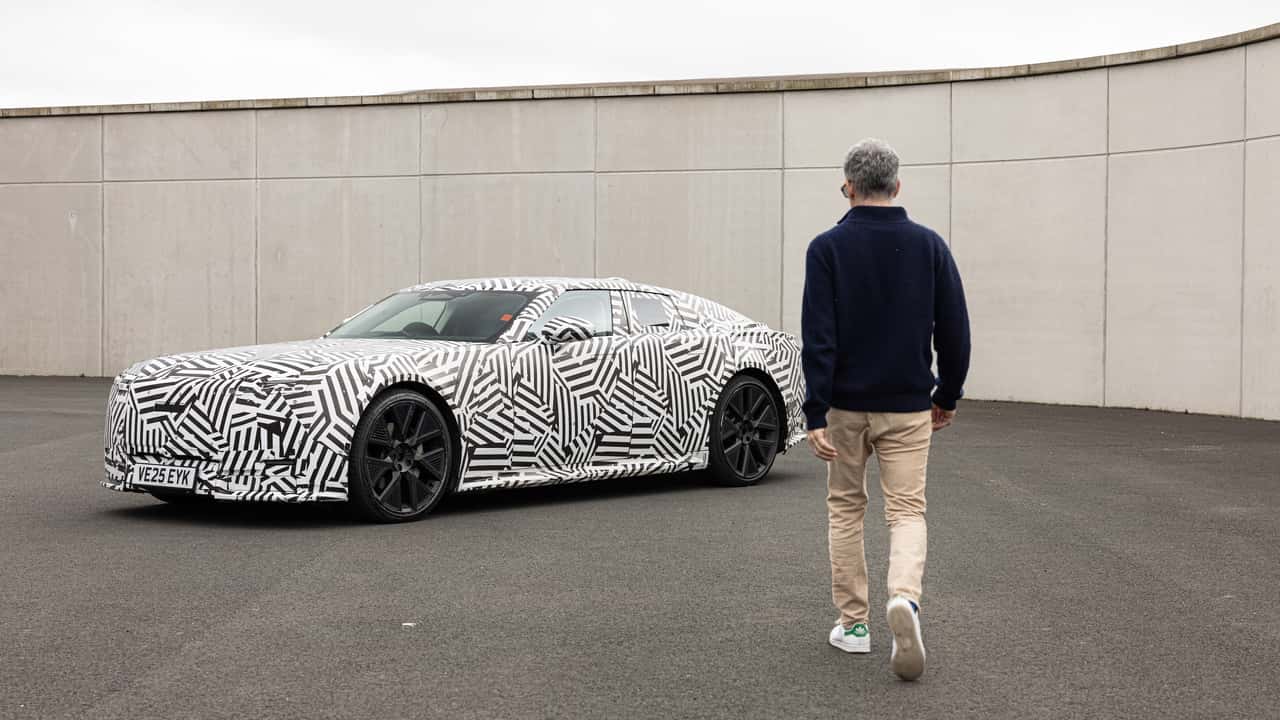
 Jaguar’s next chapter has quietly arrived behind a swirl of camouflage and anticipation. Beneath a cloak of black-and-white diagonal lines—patterns that evoke the disorienting artistry of mid-1970s Jasper Johns—the prototype of Jaguar’s upcoming electric flagship, code-named X900, prowls across its English proving grounds. The car’s veiled body conceals not just a design identity, but the weight of an entire brand’s future.
The Midlands-based test facility, built on an old Royal Air Force runway, doubles as Jaguar’s development laboratory. There, the automaker is preparing a new path forward: a six-figure luxury sedan with more than 1,000 horsepower, running entirely on electric power. Its significance can’t be overstated. The brand’s survival may hinge on this machine.
A Disguised Cat with Familiar Cues
The interior of the camouflaged car feels unfinished—a dark cocoon lined in felt that absorbs light as completely as a magician’s stage curtain. But one small clue betrays what lies beneath. The delicate yet distinctive typeface on the thin digital display behind the steering wheel, a quirky mix of upper- and lower-case letters, instantly identifies the dashboard as Jaguar’s.
Sliding behind the thick steering wheel, the first impression is one of balance rather than brute force. Acceleration is deliberate and confident, rather than neck-snapping. Unlike the ferocity typical of a Tesla or Lucid sedan, the X900’s response is tuned for poise. There’s an ever-present reserve of energy, yet it translates to movement with an elegance that echoes Jaguar’s historical emphasis on refinement over aggression.
Performance That Honors the Past
Jaguar’s sedans have long symbolized the brand’s most complete expression of its character—graceful performance fused with luxurious restraint. The X900, even as a prototype, evokes these same values. When pressed on the track’s mile-long straight, power comes on continuously and smoothly, resembling the surge of a well-tuned V12 rather than the digital immediacy of many modern EVs. The braking process is similarly intuitive, with mechanical confidence instead of an overbearing regenerative artificiality.
Ride quality, always a hallmark of Jaguar engineering, proves revelatory. On a simulated stretch of ragged, broken pavement, the prototype remains serene. The adaptive air suspension soaks up impacts while maintaining tactile stability through the steering wheel. It’s athletic but never harsh—a harmony between agility and comfort that recalls some of the best Aston Martins engineered under the same dynamics expert, Matt Becker, whose lineage traces to Lotus legend Roger Becker.
Designed from the Ground Up
The X900 rides exceptionally low, aided by clever packaging that allows its structural battery to stretch beneath the firewall, freeing cabin space and maintaining an ideal 50/50 weight distribution. Sitting deep within the cockpit, the driver experiences a sensation closer to being enveloped than perched, a design evoking Jaguar coupes of decades past.
Despite its futuristic ambitions, not all experiments land perfectly. The car lacks a rear windshield—part technical necessity, part design flourish. A rear camera system replaces a traditional mirror, though this prototype’s system was not yet functional. Similarly, the rear seats remain off-limits, masked beneath covers, leaving questions about passenger comfort unanswered.
Inside, screens play a quieter role than in rival luxury EVs. A single narrow digital panel stretches behind the wheel and across part of the dash, handling basic vehicle functions. Another small tablet-like screen protrudes from the center console to manage heating and air conditioning. Hard switches are nearly absent—a minimalist approach that might eventually face regulatory challenges in Europe and China as authorities push automakers to restore physical buttons for safety.
A High-Stakes Gamble
Yet, the true narrative here extends beyond design or performance. Jaguar is redefining its business model around exclusivity. Gone is the ambition to chase the German establishment across every segment. Instead, the automaker aims to produce a more focused range of high-end electric vehicles, starting at around $130,000. That strategy may yield prestige—but possibly at the expense of volume. Industry benchmarks are sobering: Lucid sold only about 4,000 Air sedans in the U.S. last year; Porsche’s Taycan and BMW’s i7 performed similarly. Even these brands offset limited sales with broad model portfolios, something Jaguar does not currently possess.
The X900’s success, then, must do double duty—redefining Jaguar’s image while proving financial viability in an evolving luxury EV market. External uncertainty compounds the risk. With shifting political winds affecting energy policy and global instability disrupting investments, predicting buyer behavior becomes nearly impossible.
The Reinvention of a Legacy
Still, driving even this early prototype reveals something deeply Jaguar: composure, character, and a willingness to move against convention. For decades, the brand has thrived on its ability to fuse tradition with daring design. As the automotive world tilts toward electrification, Jaguar’s bet on the X900 feels as necessary as it is audacious.
If this electric super-sedan can deliver both performance and personality at production readiness, Jaguar may yet reclaim its role as a leader of stylish innovation rather than an echo of its past. The X900 stands as a signal flare from Coventry—evidence that the leaping cat may still have one elegant pounce left in it.
All EV Sales Research Team
4/2/2026