
 Buy & Sell
 All EV Sales
 Explore
 Account
 Back to News
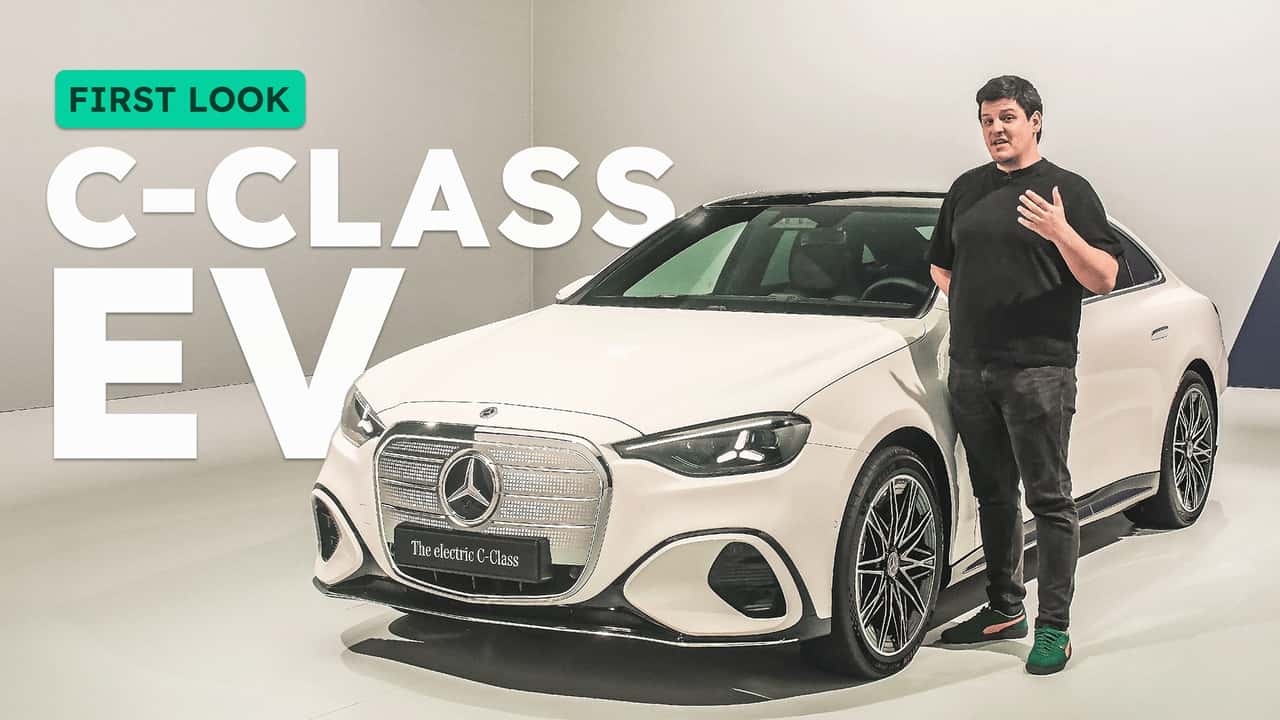
 Mercedes-Benz has unveiled its fully electric C-Class, the third model in its growing lineup of next-generation EVs built to resemble their gasoline siblings. Following the CLA and GLC electrics, this new sedan continues the brand’s mission to make the transition to electric power as seamless—and as visually familiar—as possible.
A Subtle Yet Striking Design
At first glance, the C-Class EV looks distinctly Mercedes, and that’s exactly the point. The brand’s approach here is evolution, not revolution. The front fascia takes cues from the GLC EV, recognizable by its illuminated grille filled with dozens of star-shaped light points and a surrounding LED frame that modernizes the company’s signature styling cue. Beyond that flourish, the design remains conservative—smooth lines, minimal creases, and a sense of restrained confidence.
The rear end deviates slightly from tradition. Instead of the usual sedan trunk, Mercedes opted for a fastback silhouette it calls an “athletic GT rear design.” This shape isn’t just aesthetic—it plays a role in aerodynamics, achieving an impressive drag coefficient of 0.22, even lower than that of the current combustion-powered C-Class. That figure hints at the focus on efficiency that runs through the entire car.
Seen in person, the electric C-Class sits slightly taller than its gasoline sibling, a result of the battery packaging beneath the floor. Mercedes designers attempted to mask this extra height with blacked-out side skirts, visually slimming the profile. It doesn’t quite hide the bulk completely, but the overall elegance is intact.
More Space, But Mixed Comfort in the Rear
The EV’s 116.6-inch wheelbase is about 3.8 inches longer than the gas version, a change that should translate to slightly better interior packaging. Mercedes claims an extra half inch of legroom up front, though in practice, the difference is hard to feel. The rear seat, meanwhile, still feels somewhat tight, particularly for taller passengers. The seat rails prevent feet from sliding easily underneath, which diminishes the sense of space.
Up front, however, the driving environment is quintessential Mercedes—polished, high-tech, and immersive. The seating position allows for a low, sporty posture with plenty of steering wheel adjustment. The dashboard is dominated by digital real estate: buyers can opt for a seamless 39.1-inch pillar-to-pillar display, or a standard setup of three distinct screens integrated across the dash. Either way, the interface feels futuristic but refined, continuing the design philosophies already seen in the CLA and GLC EVs.
Advanced Tech and Smarter Interactions
Running behind those screens is the latest MB.OS infotainment platform. Unlike many rivals, Mercedes built it entirely in-house rather than using Android Automotive. It still integrates Google Maps natively, while a multi-agent AI system determines whether to handle driver queries using ChatGPT or Google Gemini, depending on context. The result is conversational and quick, blurring the line between digital assistant and co-pilot.
Material quality has also taken a step forward. Interestingly, the C-Class EV feels slightly more premium than the electric GLC SUV in certain areas. Soft-touch materials extend further down the doors and console, replacing the harder plastics found in its SUV sibling.
Strong Performance and Clever Engineering
The C-Class EV rides on the MB.EA 800-volt platform, just like the GLC, which promises both efficiency and sportiness. Mercedes emphasizes that this version might be its most dynamic yet, benefiting from a lower center of gravity and a lighter footprint. The available combination of rear-wheel steering and air suspension enhances both agility and ride comfort. The rear wheels can pivot up to 4.5 degrees opposite the fronts at low speeds, shrinking the turning circle to 36.7 feet, while at highway speeds they synchronize for improved stability.
Mercedes’s Car-to-X technology adds another layer of smart functionality. It allows vehicles to share road-condition data—if one car detects a pothole or rough surface, others nearby can automatically adjust suspension height and damping in anticipation. This not only improves comfort but contributes to safety and long-term durability.
Big Battery, Fast Charging, and Long Range
Equipped with the same 94.3-kWh battery pack as the GLC EV, the sedan manages to stretch its efficiency further, with a WLTP-rated range of up to 473 miles (762 kilometers). Mercedes claims it supports 330 kW peak charging, though in practice, charge speeds beyond that—around 353 kW—have already been observed. In ideal conditions, a 10-minute top-up can add around 202 miles of range. Energy recovery through regenerative braking can reach 300 kW, meaning friction brakes will rarely be called upon during everyday use.
Power comes from a dual-motor setup producing 482 horsepower, enough to launch the C400 4Matic Electric from 0 to 62 mph in just 3.9 seconds. The rear motor includes a two-speed transmission, improving both off-the-line performance and overall efficiency. The front motor can decouple entirely when cruising, conserving energy.
Thoughtful Practicality and a Realistic Market Position
Despite its sleek lines, practicality hasn’t been ignored. Luggage space totals 16.6 cubic feet, slightly surpassing the conventional version’s trunk. There’s also a small frunk that should hold about the same as the GLC EV’s, around 4.5 cubic feet.
The new C-Class EV joins a fiercely competitive sector, going up against the likes of BMW’s i3 sedan, Zeekr’s 7GT, and the ever-present Tesla Model 3. Mercedes believes its blend of design familiarity, digital intelligence, and driving refinement will set it apart. As CEO Ola Källenius put it, the goal is to redefine what mid-size luxury means in an electric age—delivering sportiness, comfort, and smarts in a single package.
Whether it earns that claim will depend on real-world driving impressions, but based on the first encounter, the C-Class EV looks every bit the premium all-rounder that Mercedes fans have been waiting for.
All EV Sales Research Team
4/20/2026