
 Buy & Sell
 All EV Sales
 Explore
 Account
 Back to News
 For a brand that began with lightweight pedal-assist bikes in Europe, Tenways has made an ambitious leap into the more competitive, higher-powered commuter e-bike category with the Wayfarer. This latest addition to the company’s lineup aims to combine comfort, speed, and everyday utility—at a price that still feels approachable for riders entering the mid-range performance e-bike market.
After spending more than a hundred miles testing the Wayfarer across everything from city streets to mountain roads, the overall impression is that Tenways may not be a household name yet, but it’s certainly earned a place in the conversation. The Wayfarer feels like a well-rounded, thoughtfully designed electric bike that does nearly everything right for its $1,999 price tag.
Performance and Ride Experience
Powering the Wayfarer is a 500-watt rear hub motor that can peak at 750 watts, which delivers plenty of punch for a 66-pound bike. It handles inclines effortlessly and holds speed with confidence, which is especially noticeable when the assist mode is turned up. The Shimano Altus eight-speed drivetrain is a dependable mid-level component choice, offering predictable gear changes and durability. Matching that performance is a braking setup featuring large 203-mm hydraulic discs, giving it impressive stopping power even on downhill runs.
With a claimed 80-mile range from its 720-watt-hour LG-cell battery, the Wayfarer easily clears the bar for most commuters. Real-world numbers tend to fall lower, as with most e-bike claims, but endurance on this model is strong. During vigorous rides, users can expect around 50 miles from a full charge, and lighter use in Eco mode could push it higher. Charging from empty takes roughly 4 to 5 hours, making it easy to top up during a workday.
Design and Comfort
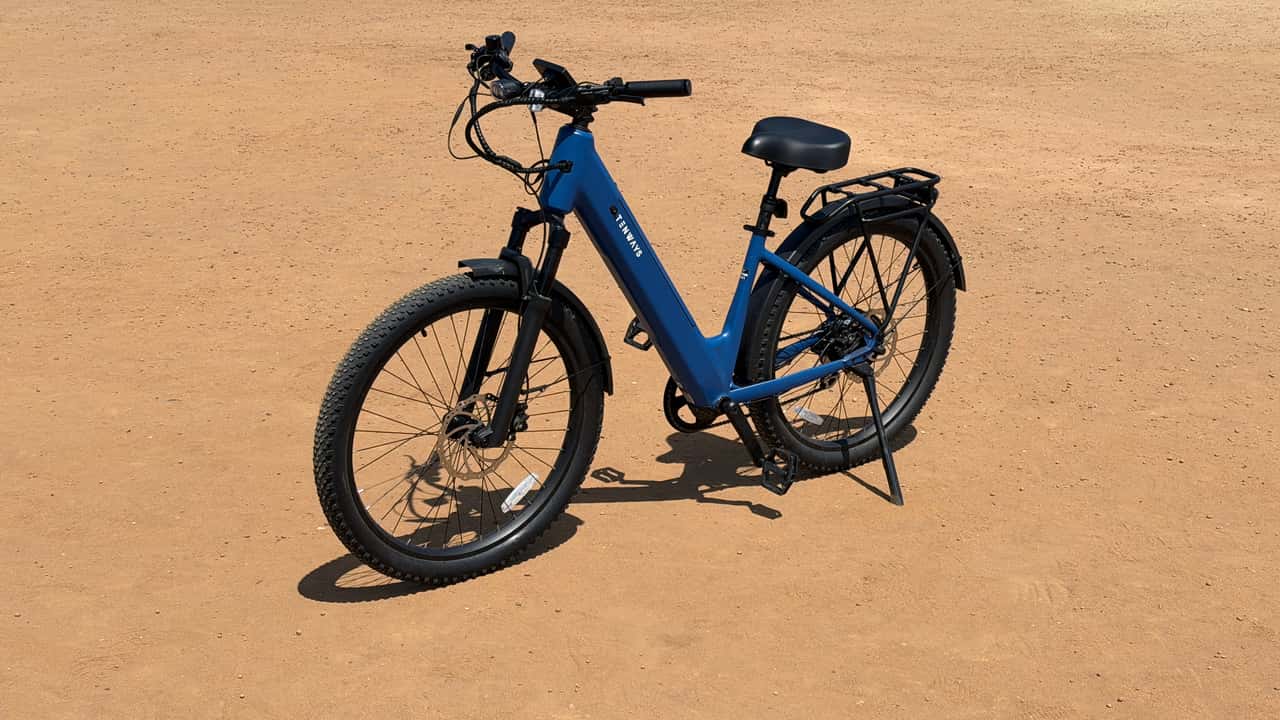
The Tenways Wayfarer looks sharp in its matte blue paint—though a light gray version is also available—and it’s immediately striking how sturdy and balanced it feels. Despite being a step-through frame, which often sacrifices rigidity for ease of use, the bike remains stable even when traveling at its top assist speed of 28 miles per hour. The air front fork and seat-post suspension soak up imperfections in the road without muting the feeling of control. Combined with 27.5 x 2.6-inch Kenda all-terrain tires, it’s comfortable on urban routes, gravel paths, and even scenic beachside trails.
Standard accessories such as a cargo rack, fenders, and kickstand add function without extra hassle. Technically, these items belong to a paid accessory package, but at the time of review, Tenways appears to be including them for free to newsletter subscribers—a clever move that adds value. A hidden Apple Find My-compatible tracker in the bell is another thoughtful feature, adding peace of mind for riders worried about theft.
Controls and Usability
At the heart of the electronics is a Bafang controller paired with a 4.3-inch color display. The screen layout is intuitive and bright, easy to read even in full sun. Navigation through menus and assist levels (Eco through Boost) is quick, but the system isn’t flawless. Occasional freezes required the rider to restart or re-enter the startup PIN using the small up-and-down arrows—a minor but irritating quirk. The same goes for the handlebar control pad placement, which is a bit too far inward, making functions like turn signals awkward to use.
Lighting on the Wayfarer is functional but unspectacular. The headlight is bright enough for urban riding, though it takes some trial-and-error to position it for both visibility and road illumination. It’s good for safety but not ideal for pitch-dark paths, so riders who frequently hit the streets after sunset may want to consider upgrading.
Modes, Speed, and Real-World Versatility
The Wayfarer supports multiple operation classes: Class 1, Class 2, Class 3, and an “Unlimited” mode. Out of the box, it runs as a Class 2 e-bike, meaning pedal assist and throttle are available up to 20 mph. Switching to Class 3 raises the assist limit to 28 mph but disables the throttle to remain compliant with stricter regulations in some regions. For those in areas without those restrictions, the Unlimited mode allows speeds approaching 29 mph while keeping throttle control active. It’s worth noting that actual use of Unlimited mode may run afoul of local laws, so discretion is advised.
Practicality is a recurring theme throughout the Wayfarer. It keeps pace with traffic more easily than most commuter bikes, giving the rider confidence and safety when blending into faster-moving lanes. Strong braking performance backs up that sense of assurance, while the torque-sensor-based pedal assist feels remarkably natural—the motor adds power effortlessly in proportion to pedaling effort. That said, riders should note that when in a low gear with high assist, the torque response can sometimes overshoot, briefly making the pedals feel like they’re spinning themselves.
Minor Gripes, Major Value
There are only a few drawbacks to mention. Aside from the finicky display PIN entry and control layout, the biggest oversight is perhaps the lack of a dedicated water bottle mount—an odd omission on a bike so clearly built for commuting and longer rides. A handlebar-mounted cupholder works in a pinch, but it’s far from elegant.
Ultimately, the Tenways Wayfarer nails the essentials: range, speed, comfort, and confidence. It’s quick enough to make commuting fun, robust enough for weekend adventures, and stylish enough to turn heads. In a market crowded with well-known rivals, it manages to carve out a niche with practicality and polish at an attractive price. For riders looking to take the leap into e-bike commuting without breaking $2,000, the Wayfarer more than earns its name.
All EV Sales Research Team
5/15/2026