
 Buy & Sell
 All EV Sales
 Explore
 Account
 Back to News
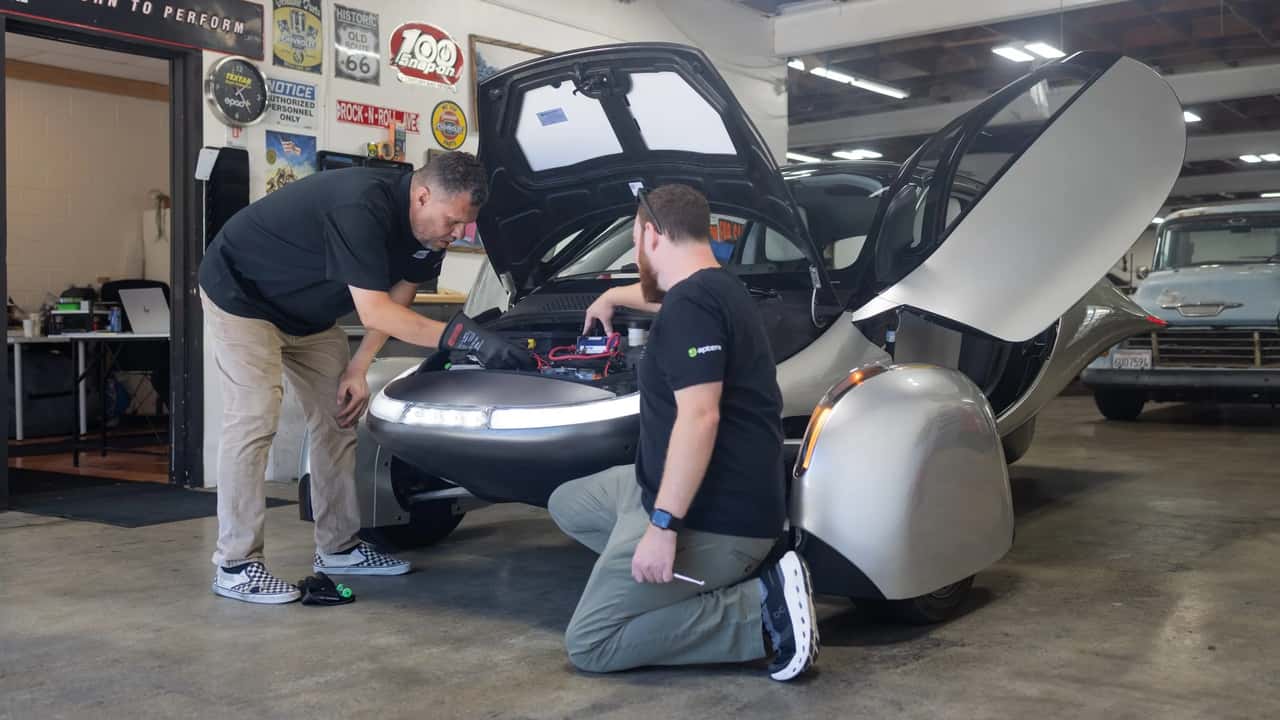
 California-based startup Aptera, well known for its prolonged journey toward launching a solar-powered electric vehicle, has announced a new partnership that could solve one of the most pressing challenges for any emerging automaker: after-sales service. Instead of pouring resources into building its own maintenance and repair network, Aptera has partnered with RepairPal, a national network of more than 4,300 certified independent service centers across the United States.
This strategic move marks a clear shift in how smaller EV manufacturers might handle customer support and service in the face of limited capital and workforce. Giants like Tesla and Rivian invested heavily in creating their own service infrastructures to ensure control and quality, but that approach demands billions of dollars in logistics, personnel, and property. Aptera is taking another route—leveraging existing expertise and infrastructure to provide customer service from day one. It’s a move reminiscent of another EV newcomer, Slate Auto, which announced a similar collaboration last year to manage service through third-party networks.
According to Aptera, RepairPal’s broad nationwide network means that buyers of its upcoming three-wheeled solar car will have quick access to repair and maintenance options, whether for routine checkups or complex high-voltage system issues. The company noted that more than 200 of these locations are already certified for high-voltage EV repairs, which puts Aptera in a relatively good position to support customers once deliveries begin. In addition to standard training, RepairPal technicians are expected to receive specialized instruction on the unique aspects of Aptera’s composite body, solar array integration, and its nontraditional powertrain setup. However, the firm has not yet shared details on how this rollout will be phased or when technicians will start receiving these updates.
From a financial perspective, this partnership could prove to be an essential cost-saving measure. Establishing an in-house service operation would require Aptera to invest heavily in facilities, tools, and personnel across all major markets. By outsourcing those functions, the company preserves cash for what it considers its main priority: completing development and scaling up production of its long-promised solar EV.
As of now, however, the production timeline remains somewhat nebulous. Despite a two-decade-long journey filled with stops, starts, and reboots, Aptera is closer than it has ever been to delivering a production-ready car. A validation assembly line is currently operating at low volume, and five beta vehicles have been spotted testing on public roads. The company recently celebrated a milestone when its Launch Edition received a certificate of conformity from the U.S. Environmental Protection Agency—an important regulatory step toward delivering actual vehicles.
Yet even as milestones accumulate, Aptera remains an early-stage manufacturer operating on a shoestring budget relative to established automakers. In its most recent quarterly report, the company disclosed that it employs only 57 people, a 54% increase over the previous year. It reported $17.7 million in cash and cash equivalents, a figure that highlights the lean nature of the enterprise compared with billion-dollar giants like General Motors or Tesla. For that reason, the choice to avoid building a service ecosystem internally seems more pragmatic than risky.
The company’s transparency about its financial standing doesn’t seem to have scared off potential buyers. Aptera continues to claim nearly 50,000 reservations for its solar vehicle, reflecting growing interest in lightweight, ultra-efficient EVs that can harness renewable energy directly from the sun. The upcoming Launch Edition model promises about 400 miles of range on a full charge, delivered through a front-wheel-drive layout, and is targeted to start at around $40,000. Other configurations are set to follow: a base model with 250 miles of range priced near $28,000 and a top-tier version capable of 1,000 miles expected to cost about $55,000.
Aptera’s solar panels, integrated into the curved surfaces of its aerodynamic, two-seat body, are projected to add between 22 and 40 miles of range per day based on sunlight exposure and configuration. The vehicle includes a high-voltage battery compatible with both home charging systems and public stations via a North American Charging Standard (NACS) connector—the same port design now favored by Tesla and increasingly adopted across the industry. This inclusion ensures that owners will be able to charge at a wide range of stations already equipped with this rapidly standardizing connector.
While enthusiasm remains high, production realities continue to temper expectations. The startup still faces the challenge of scaling manufacturing capacity, securing reliable component supply chains, and navigating regulatory hurdles for its unconventional three-wheeled classification. Delivery estimates have quietly disappeared from its website, though company officials emphasize that the EPA certification and service partnership show tangible progress toward commercialization.
For now, Aptera’s collaboration with RepairPal provides a glimmer of stability for early adopters worried about where they might turn for maintenance or unexpected repairs. It also demonstrates that even smaller EV players can begin operations without the often crippling financial burden of creating vertical service structures from scratch. If the rollout goes smoothly, Aptera’s approach could become a model for how micro-manufacturers bring innovative vehicles to market in an increasingly competitive electric-vehicle landscape.
All EV Sales Research Team
7/15/2026