
 Buy & Sell
 All EV Sales
 Explore
 Account
 Back to News
 The electric-vehicle market is entering a more practical phase
The latest electric-vehicle news points to an industry moving beyond headline range figures and experimental concepts. Automakers, charging companies, battery manufacturers, repair specialists and regulators are all competing to make EV ownership more useful, affordable and convenient. At the same time, buyers are being asked to navigate recalls, software delays, charging losses and a growing number of vehicles designed for very different purposes.
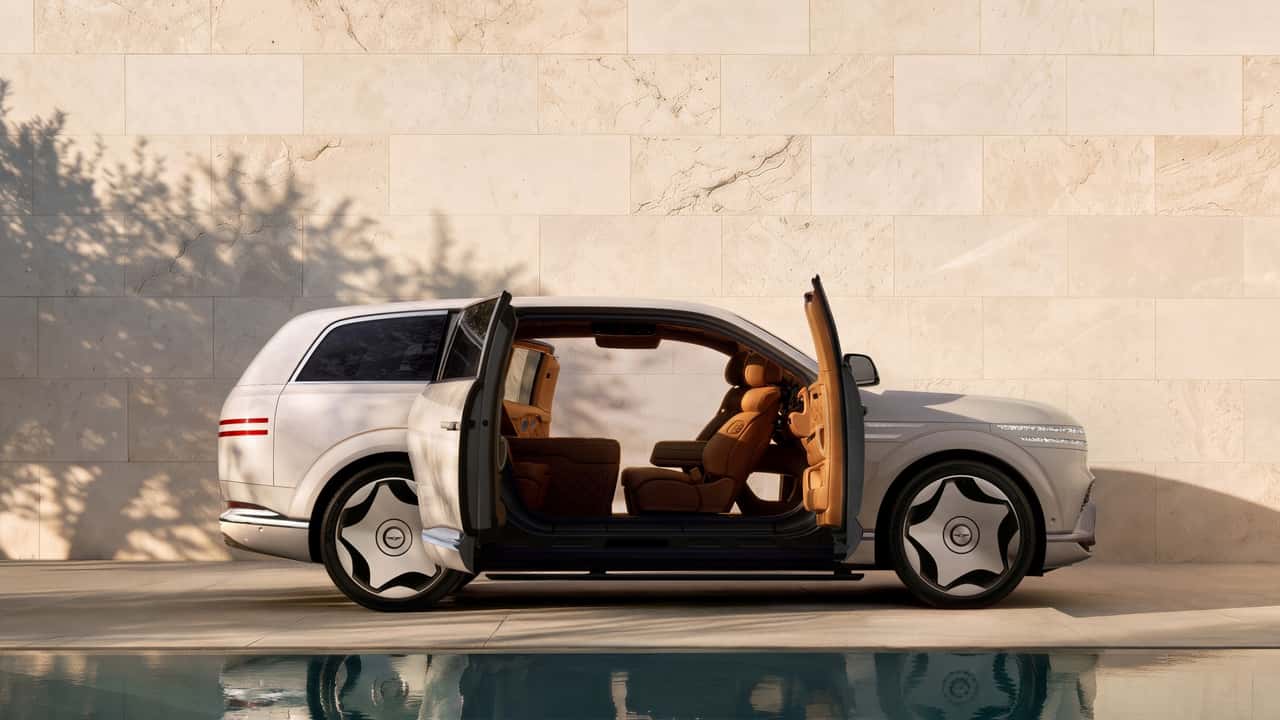
One of the clearest trends is the expansion of EVs into new categories. Large electric SUVs are being developed not only as family transportation but also as mobile living spaces. The upcoming Genesis GV90, for example, is expected to emphasize its enormous interior and swiveling front seats, allowing four occupants to create a lounge-like cabin. That approach reflects a broader effort to make electric vehicles feel different from conventional cars rather than simply replacing gasoline powertrains with batteries.
At the opposite end of the market, Fiat is promoting a tiny electric vehicle that is closer to a golf cart than a traditional automobile. Its goal is to challenge America’s enormous golf-cart industry, which is worth roughly $1 billion. The concept highlights how electrification can create products for short urban trips, resorts, neighborhoods and other environments where full-size cars may be unnecessary. A similar focus on compact utility is visible in Telo’s planned electric pickup. The startup says its small truck will provide four doors, a 350-mile range and a bed as long as that of a four-door Toyota Tacoma.
Range claims are being tested in the real world
Real-world usability remains one of the most important themes in the EV market. A road test that involved driving from one location to another, rather than relying on laboratory conditions or generous CLTC estimates, showed why official range figures should be interpreted carefully. Another newly launched electric crossover exceeded its advertised range by more than 30 miles, offering a welcome example of a vehicle outperforming expectations.
However, range is only one part of long-distance driving. Germany’s largest automobile club recently compared several EVs for charging losses—the energy consumed between the charger and the battery—and found that one model performed noticeably worse than the others. These losses can affect both the real cost of charging and the amount of electricity required to cover a given distance. The findings reinforce the importance of efficiency, charging performance and battery management rather than focusing exclusively on the size of a vehicle’s range estimate.
Charging access is also becoming more competitive. One company is attempting to challenge established networks such as Tesla’s Supercharger system and Electrify America primarily through lower prices. Meanwhile, testing showed that charging a Tesla using equipment from major competitors can work surprisingly well, despite the rivalry between networks. The growing compatibility between vehicles, adapters and charging providers could gradually make public charging less fragmented.
Software, hardware and vehicle support remain challenges
Not every development is positive. Tesla owners with older Hardware 3 vehicles have been waiting for promised advances for nearly two years, and at least one owner became frustrated enough to pursue an alternative rather than continue waiting. The issue illustrates the tension created when automakers sell vehicles whose capabilities are expected to improve through future software and hardware updates.
Vehicle support after the initial sale is also receiving attention. A specialist that remanufactures motors for Tesla Model S vehicles is now offering similar services for the more affordable Kia Niro EV and Hyundai Kona Electric. Repair and remanufacturing businesses could become increasingly important as early EVs age, helping reduce costs and limiting the environmental impact of replacing entire drive units.
Safety campaigns continue as well. A recall that began last year has been expanded after additional vehicles were identified as potentially having faulty turn signals. Such announcements show that EVs face many of the same quality-control challenges as gasoline vehicles, even though their powertrains are fundamentally different.
Manufacturing, autonomy and global competition
Battery production is continuing to expand in the United States. A new Lansing, Michigan, facility is expected to employ as many as 1,700 people and produce up to 35 gigawatt-hours of batteries annually. Projects of this scale are intended to strengthen domestic supply chains while supporting the production of more electric vehicles in North America.
China remains a major source of EV innovation and competition. Xiaomi, a company better known for manufacturing mobile phones, has reached a significant milestone in its transition into the automotive business. Audi, meanwhile, has kept two Chinese-market electric models officially out of Europe, but a third-party importer is bringing them to the continent anyway. The development illustrates how consumer interest can bypass traditional market strategies when desirable vehicles are not offered through official channels.
Autonomous transportation is also moving into heavier vehicles. California’s Department of Motor Vehicles has issued the first permits allowing companies to test heavy autonomous vehicles on public roads. The permits could accelerate experimentation with autonomous trucking and freight operations, although safety oversight and public acceptance will remain essential.
Sustainability and luxury take different paths
The environmental case for EV adoption is being examined more closely. A recent study concluded that replacing an internal-combustion vehicle with a new EV can be better for the climate than continuing to operate the older vehicle. The result depends on factors such as battery production, electricity generation and vehicle lifetime, but it challenges the idea that keeping every existing gasoline car on the road is automatically the greener choice.
Luxury manufacturers are also exploring sustainability beyond the powertrain. Bentley is applying its emphasis on high-quality materials to environmentally focused interior design, including Merino wool and recycled wood in the Torcal concept. At the same time, Ferrari is preparing to sell a unique vehicle at auction without retaining any of the proceeds, emphasizing exclusivity and philanthropy rather than mass-market electrification.
Finally, the market is beginning to distinguish between features that are standard and those that cost extra. Tesla Model Y Premium buyers in the United States can purchase an adapter for $80 to enable power export, while Hyundai offers comparable vehicle-to-load functionality at no additional charge. That contrast reflects a broader competitive question: as EVs become rolling energy-storage devices, will useful capabilities be premium options or expected equipment?
Taken together, these stories show an EV sector becoming broader and more mature. The next stage will be defined not just by battery size, but by affordability, charging economics, repairability, manufacturing scale, real-world efficiency, software support and the ability to serve everything from urban errands to long-distance travel.
All EV Sales Research Team
8/20/2026