
 Buy & Sell
 All EV Sales
 Explore
 Account
 Back to News
 The EV Market’s Next Chapter: Faster Charging, Smarter Driving, and a Broader Definition of Electric
The latest electric-vehicle news points to an industry moving beyond a single obsession with battery range. Automakers, charging companies, autonomous-driving developers, and new mobility startups are all working on different pieces of the same transition: making electric transportation more practical, more affordable, and easier to use in everyday life.
One of the clearest trends is the continued expansion of charging infrastructure. BYD’s Flash Charging network has reportedly reached 10,000 stations, a milestone that illustrates how quickly charging ecosystems are developing outside the traditional networks associated with North American and European automakers. Particularly notable is the fact that roughly one-third of Flash Charging users do not drive a BYD. That suggests reliable infrastructure can attract drivers across brands, turning charging networks into an important part of the broader transportation system rather than merely a sales tool for the company that operates them.
Charging speed is also advancing rapidly. The Yangwang U7 is reported to charge from 10% to 97% in only nine minutes, raising obvious questions about heat, degradation, and long-term battery health. Extremely rapid charging could make electric vehicles much more convenient on long journeys, but it also highlights the engineering challenge of balancing speed with durability. The next major battery breakthrough may not be a solid-state cell at all. Improvements in charging systems, thermal management, battery chemistry, software, and manufacturing could produce meaningful gains before solid-state technology becomes commercially widespread.
The definition of an electric vehicle is expanding as well. BMW has sold as many as 3.5 million electrified vehicles when plug-in hybrids are included, demonstrating that the transition is not occurring through battery-electric cars alone. Hyundai is also preparing an extended-range electric vehicle to be built at its Alabama plant. These vehicles may offer electric driving for daily use while retaining an engine or generator for longer trips, potentially appealing to buyers who remain concerned about charging access or road-trip convenience.
Affordability remains one of the industry’s biggest challenges. The new Chevrolet Bolt is expected to have a limited production run, but it represents a substantial improvement over its predecessor and reinforces the importance of compact, relatively accessible EVs. At the other end of the market, Tesla’s least expensive Cybertruck is now priced at nearly twice the starting figure discussed when the vehicle was introduced in 2019. Tesla’s planned Cybercab launch has also revived questions about whether a $30,000 autonomous vehicle can actually reach consumers at that price, or whether the figure is more aspirational than imminent.
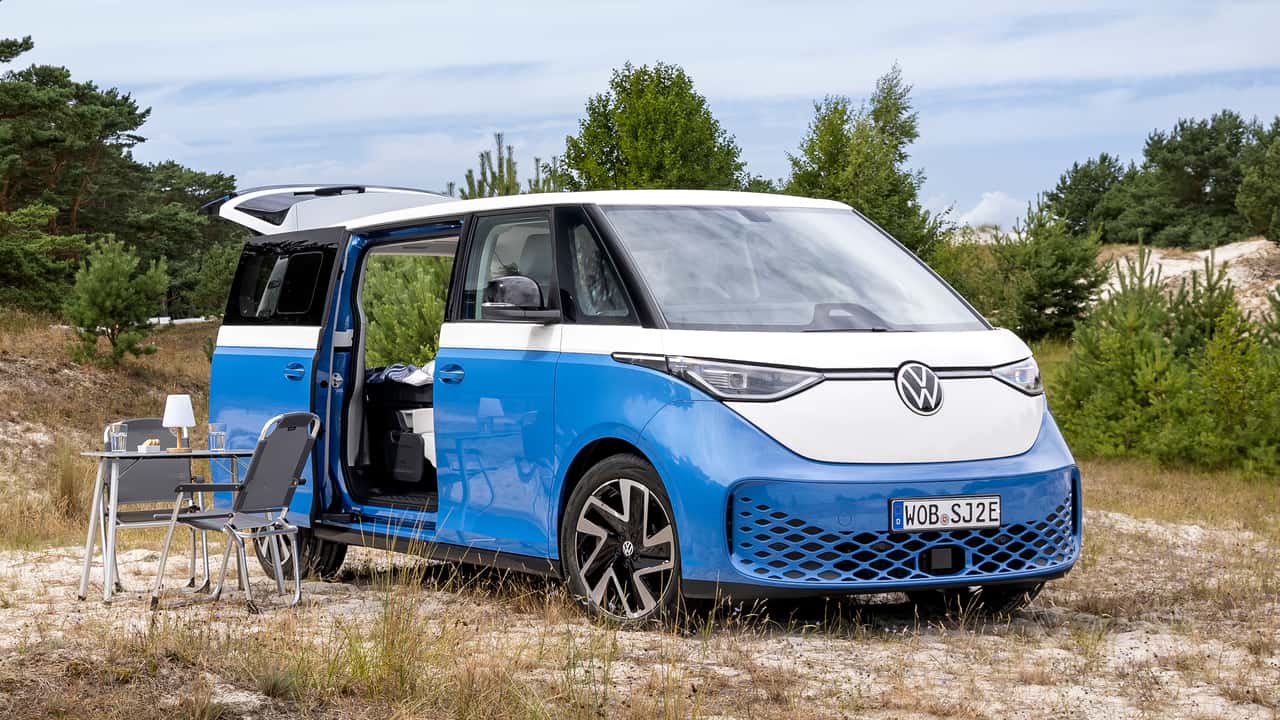
New vehicle formats are emerging alongside traditional cars and trucks. Volkswagen’s ID. California Cruise transforms the retro-styled ID. Buzz into a simple camper van, with a U.S. version reportedly planned. The model reflects growing interest in electric vehicles as lifestyle products, not just commuting appliances. Aptera, meanwhile, is promoting its highly aerodynamic three-wheeler and has backed its efficiency claims with independent TÜV Rheinland testing. While such vehicles occupy a niche, they demonstrate how designers are experimenting with shape, weight, and purpose to extract more distance from every kilowatt-hour.
Convenience is also influencing charging design. Voltpost has introduced chargers that attach to ceilings and walls, potentially reducing installation costs and making them better suited to apartment buildings and dense urban areas. For people without private garages or dedicated parking spaces, solutions like these may be more important than headline charging speeds. The success of mass EV adoption will depend not only on how quickly a car can charge, but also on whether drivers can access a dependable charger where they live, work, and shop.
Safety and driver assistance remain major themes. Volvo is developing systems capable of detecting deer, people, and other hazards before a driver notices them. Tesla’s Full Self-Driving software has reportedly shown surprising capability on roads where pavement disappears, although performance in difficult environments does not eliminate the need for driver supervision. Waymo is taking a different approach: one of its senior engineers has argued that cameras alone are insufficient for autonomous driving, while the company prepares to map Munich ahead of a planned service launch next year. The debate over cameras, lidar, radar, and sensor redundancy remains unresolved, but the industry increasingly recognizes that autonomous driving requires more than impressive demonstrations.
The business side of the EV sector is under pressure as companies scale production and attempt to reach profitability. Claire McDonough, a longtime executive at Rivian, is leaving after six years as the company works to increase R2 sales. Leadership changes of this kind reflect the difficult transition from startup development to high-volume manufacturing. Rivian and other newer automakers must control costs, deliver vehicles reliably, and build service networks while competing with established manufacturers.
Reliability concerns have not disappeared. More than 27,000 Lucid Air sedans are being recalled because of a fire risk, although the company says the remedy can be delivered through an over-the-air software update. The recall illustrates both the risks of increasingly software-defined vehicles and the potential advantage of connected cars: some problems can be corrected without requiring every owner to visit a dealership.
Taken together, these developments show an EV market becoming more diverse and technically sophisticated. Progress is arriving through charging networks, alternative powertrains, lightweight designs, software updates, driver assistance, autonomous systems, and new ownership experiences. The winners may not be the companies with one spectacular feature, but those that combine affordability, dependable infrastructure, safety, durability, and convenience into vehicles people can comfortably use every day.
All EV Sales Research Team
8/30/2026